Students,
Please take a look at the Chemical and Physical Change Prezi below. You will learn what a chemical change is and how you might know that a chemical change has taken place. Also, you will learn what a physical change is and be introduced to 4 different examples of physical change. Please pay particular attention to how chemical and physical changes are different.
Has your bicycle chain ever rusted? Would this be an example of a physical or chemical change? How do you know?
If your bicycle tire loses air and goes flat, would this be an example of a physical change or chemical change? How would you know?
Please share your thoughts in the comments section below.
Lastly, before class tomorrow, go on a 'Chemical Change or Physical Change Scavenger Hunt'. Look for other examples of chemical and physical changes in your home and bring your ideas to class!
I can't wait to hear all of your great ideas!
Sunday, February 19, 2012

Monday, February 6, 2012
The Tremendous Title
Students, parents and guardians,
In a media-rich world in which we are exposed to advertisements seemingly everywhere, how do companies attempt to make themselves stand out above the rest?
We’ve already taken a look at the Contact and Illustration components of print advertisements, let’s now examine the title
Print advertisement component #3: title
The title of a print advertisement is its main headline. Sometimes the title is the most noticeable part of a print advertisement, sometimes it is not. Print advertisements may also have a subhead which is a subordinate or minor title.
In the print advertisement below, the title is: The Ultimate Quick Fix.
Consider the size of the words and the placement of the title. How effective is this title? Is bigger always better?
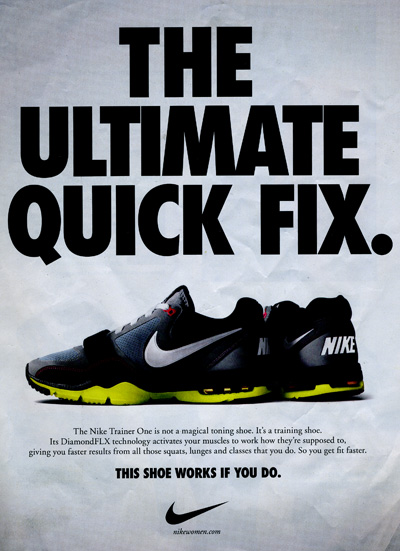 Retrieved from: http://www.adweek.com/news/advertising-branding/nike-fix-fails-103023
Tonight, please take the time to look through a magazine or newspaper (a print copy or an online version), and pick out a headline that caught your attention. Please share this headline in the comments section below and tell us why you found it so intriguing. We'll discuss your findings tomorrow.
If you're not too sure where to look for online magazines or newspapers, here are a few websites to get you started:
Time for Kids: http://www.timeforkids.com/
First News: http://www.firstnews.co.uk/
Time magazine: http://www.time.com/time/
The Globe and Mail: http://www.theglobeandmail.com/
In a media-rich world in which we are exposed to advertisements seemingly everywhere, how do companies attempt to make themselves stand out above the rest?
We’ve already taken a look at the Contact and Illustration components of print advertisements, let’s now examine the title
Print advertisement component #3: title
The title of a print advertisement is its main headline. Sometimes the title is the most noticeable part of a print advertisement, sometimes it is not. Print advertisements may also have a subhead which is a subordinate or minor title.
In the print advertisement below, the title is: The Ultimate Quick Fix.
Consider the size of the words and the placement of the title. How effective is this title? Is bigger always better?
Tonight, please take the time to look through a magazine or newspaper (a print copy or an online version), and pick out a headline that caught your attention. Please share this headline in the comments section below and tell us why you found it so intriguing. We'll discuss your findings tomorrow.
If you're not too sure where to look for online magazines or newspapers, here are a few websites to get you started:
Time for Kids: http://www.timeforkids.com/
First News: http://www.firstnews.co.uk/
Time magazine: http://www.time.com/time/
The Globe and Mail: http://www.theglobeandmail.com/
Sunday, February 5, 2012
Students, parents and guardians,
Have you ever seen a print advertisement in a magazine, newspaper or billboard and thought, “hey, that’s a really great picture!”. Well, that picture is called an illustration. Let’s look a little closer at this element of print advertisements.
Print advertisement component #2: illustration
The illustration of a print advertisement is the photo, drawing, or other graphic element included in it. Some print advertisements have more than one illustration, others have none.
Take a look at the print advertisements below. How are their illustrations similar? How are they different? Is one advertisement more effective than the other? Why or why not?
Please share your thoughts in the comments section below!


Retrieved from http://dailydesigninspiration.com/diverse/adv/lowe/800/Rubbermaid.jpg and http://epiccheck.com/wp-content/uploads/2011/01/maybelline-ss-2010-emily-didonato.jpg
Have you ever seen a print advertisement in a magazine, newspaper or billboard and thought, “hey, that’s a really great picture!”. Well, that picture is called an illustration. Let’s look a little closer at this element of print advertisements.
Print advertisement component #2: illustration
The illustration of a print advertisement is the photo, drawing, or other graphic element included in it. Some print advertisements have more than one illustration, others have none.
Take a look at the print advertisements below. How are their illustrations similar? How are they different? Is one advertisement more effective than the other? Why or why not?
Please share your thoughts in the comments section below!
Retrieved from http://dailydesigninspiration.com/diverse/adv/lowe/800/Rubbermaid.jpg and http://epiccheck.com/wp-content/uploads/2011/01/maybelline-ss-2010-emily-didonato.jpg
Congratulations!
Students, parents and guardians,
First, let me congratulate you all on a highly successful first week of school! Through the collaborative efforts of all students, we have begun to develop a wonderful classroom community! I have so enjoyed getting to know all of you, and am looking forward to all of our future learning endeavors. I hope you are too!
Continuing our Media Literacy unit, I'll be creating a series of blog posts focusing on the different components of a print advertisement. The purpose of these posts is to familiarize students about the different parts of print advertisements and to encourage reflection on their purpose and evaluation of their effectiveness. At the end of each post I'll ask a question or two and ask for responses in the comments section of the blog post. Parents, these questions are not just for students, I'd love to hear from you too!
Being able to critically reflect on media messages is an important skill to have in today’s media rich world.
Print Advertisement Component #1: Contact
The contact of a print advertisement can include a logo, phone number, brand name, address, website, or other company contact information.
Take a look at the print advertisement below. How important is the contact in this advertisement? Please share your thoughts in the comments section below.
 Retrieved from: http://theinspirationroom.com/daily/2008/sorbent-rabbit-fur/
First, let me congratulate you all on a highly successful first week of school! Through the collaborative efforts of all students, we have begun to develop a wonderful classroom community! I have so enjoyed getting to know all of you, and am looking forward to all of our future learning endeavors. I hope you are too!
Continuing our Media Literacy unit, I'll be creating a series of blog posts focusing on the different components of a print advertisement. The purpose of these posts is to familiarize students about the different parts of print advertisements and to encourage reflection on their purpose and evaluation of their effectiveness. At the end of each post I'll ask a question or two and ask for responses in the comments section of the blog post. Parents, these questions are not just for students, I'd love to hear from you too!
Being able to critically reflect on media messages is an important skill to have in today’s media rich world.
Print Advertisement Component #1: Contact
The contact of a print advertisement can include a logo, phone number, brand name, address, website, or other company contact information.
Take a look at the print advertisement below. How important is the contact in this advertisement? Please share your thoughts in the comments section below.
Sunday, January 29, 2012
How do they do it?
Today, as part of our Media Literacy unit on advertisements, the class brainstormed a fantastic list of advertising techniques that companies use to sell their products.
With these techniques in mind, take a look at the following commercial and ask yourself these questions:
What is the company trying to sell? How do I know?
Who is the commercial aimed at? How do I know?
What techniques does the advertiser use to sell their product and target a specific audience?
Please share your thoughts in the comments section below. We'll also discuss your ideas in class!
With these techniques in mind, take a look at the following commercial and ask yourself these questions:
What is the company trying to sell? How do I know?
Who is the commercial aimed at? How do I know?
What techniques does the advertiser use to sell their product and target a specific audience?
Please share your thoughts in the comments section below. We'll also discuss your ideas in class!
Welcome!
A smile is the universal welcome
-Max Eastman
Hello students, parents and guardians! Welcome to a new school year and to Miss. Howes' Class Blog!
As we make our journey through this exciting new year, I'll be using this blog to update you on our class work and achievements. In other words, if you’re looking for information on school events, class projects, or homework, look no more! At Miss Howes’ Class Blog you’ll find assignment topics, due dates, photos, and other great information on what we’re learning in class and what’s happening in our school.
If you don’t have previous experience with blogs or are simply unsure of their purpose in the classroom, over the course of this year I am optimistic that you will come to know the value of blogs and other such technologies in today’s schools. I hope that you will not only see Miss. Howes’ Class Blog as a place to keep ‘up-to-date’, but also as a learning tool where students can reflect on their learning, practice their writing skills, and peer review.
With that said, I’m thrilled to be starting this new school year with all of you and, in regards to the opening quote from Max Eastman, please accept this first blog post as a digital smile!
Subscribe to:
Comments (Atom)